Showing posts with label writing. Show all posts

Friday, December 7, 2012

Bringing it Together Podcast

I'm sure the title explains it all, but just in case it doesn't, I hope the images help. The following podcast serves as a conclusion to the ideas presented in this blog. Enjoy!

Image Courtesy of this site

Image Courtesy of this site

Interpreting Technology Survey Results Podcast

The following podcast discusses the results of a survey conducted from 12/3/2012 through 12/9/2012 that focused on technology use in high school and college writing courses.


To see the full survey results, please check out the "Survey Results" page.


Technology Use in the Classroom

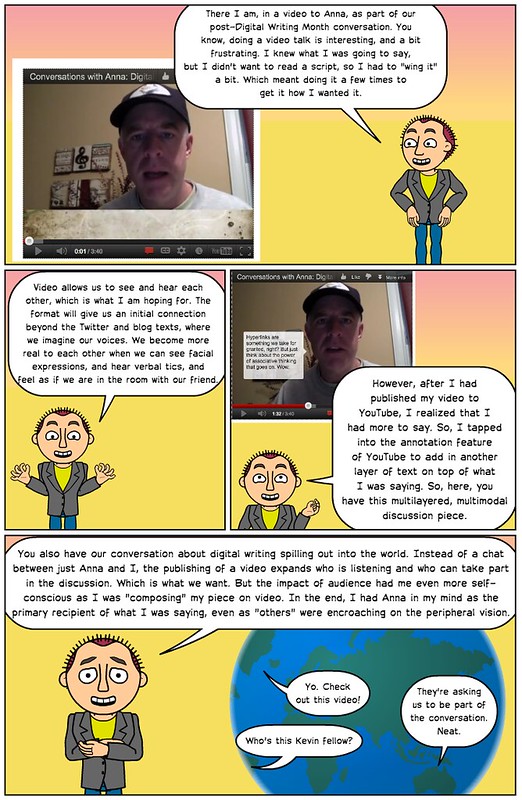
During this past summer I had the wonderful opportunity to take part in the Yellowstone Writing Project, which is a local site of the National Writing Project. The National Writing Project is a resource and community that I knew very little about during my first two years teaching, but I wish I had known more. While I have visited the main website a few times over the semester, it wasn’t until Collin Gifford Brooke re-introduced me to Google Reader that I have actively been following an online “conversation” between two people as a follow-up to NWP’s Digital Writing Month. As Anna Smith explains, “As two explorers during Digital Writing Month, Kevin Hodgson and I, Anna Smith, have decided to continue that conversation through consideration of digital literacies and contemporary composition by coordinating a multimodal conversation that begins with the idea of Digital Writing Month and then stretches outwards from there” (Smith’s hyperlinks). You can read Anna’s first blog post here, which gets the conversation started, and the video embedded below is Kevin’s first response.

As part of the conversation, both participants are engaging in reflection. As Kevin Hodgson writes, “We also want to reflect on how those platforms inform our writing." Here you can see his reflection on the video. Writing this way, through a variety of digital platforms, is the type of writing we should be striving to include in all of our writing courses.
           
To see Kevin's Post, please click here
Although Jody Shipka argues that multimodality is not exclusively associated with technology, she presents a convincing argument for asking students to create writing that is multimodal rather than monomodal, or straight alphabetic-text. She writes, “A mediated activity-based multimodal framework not only requires that students work hard but also differently, and it does so by foregrounding the complex processes associated with goal formation and attainment” (100). What Shipka is advocating for is inquiry-based learning. She and others see multimodal writing as a way to engage students in their own learning and decision making processes. Rather than passively writing a monomodal, alphabetic-text that answers a prompt, multimodal writing provides students “with tasks that do not specify what their final products must be and that ask them to imagine alternative contexts for their work”, and if this occurs, then students will “come away from the course with a more expansive, richer repertoire of meaning-making and problem-solving strategies” (Shipka 101). Looking back at the digital conversation between Anna and Kevin, we can see this decision making process in action. Kevin chose to do a video for his first post because, as he says, “Video allows us to see and hear each other, which is what I am hoping for. The format will give us an initial connection beyond the Twitter and blog texts, where we imagine our voices” (Hodgson). Even though Kevin and Anna are adults who are choosing to participate in this project, in the context of students, they have had to pick a goal and decide the best means of achieving it. Both participants realized the limitations of just one modality—blogging or Twitter, which are heavily based on written text—and so they are trying to incorporate other modalities to attain the goal of continuing this conversation. Just as importantly, as Kevin recognizes, is the need to reflect on this process in order to recognize the choices being made. As Shipka points out, “The questions comprising the SOGC ask students to focus specifically on the texts they produce in response to a task and to catalog the various rhetorical, material, methodological, and technological choices they made with their work” (118). This, Shipka argues, is really where the learning takes place. It is here that students are truly practicing rhetoric by justifying their composition choices.

However, just including technology in the writing classroom is not enough. As this article indicates, there are better ways to incorporate technology. New media should not be used to just replace what is already being done with traditional essays, but rather the entire way we conceptualize writing and what it looks like needs to be revised. At the beginning of his book Lingua Fracta, Collin Gifford Brooke gives a great example of how just using new media does not necessarily result in re-thinking writing. He argues against MaryLynn Saul’s essay “The Limitations of Hypertext in the Composition Classroom,” by noting that “Her study rests on the assumption that hypertext has little to do with writing, that it is simply a technology which can be added or subtracted from a writing classroom without any appreciable effect on the goals, aims, purposes, or strategies of the classroom or of the writers themselves” (21). In other words, it is not the technology itself that makes good writing or good writers. Instead, it is the use of the technology, the deliberate choices and defined purposes that make using new media in the classroom powerful. For instance, Doering, Beach, and O’Brien explain, “Given this ready access to these broader, even world-wide audiences, adolescents must then know how to go beyond simply creating multimodal texts to knowing how to design these texts using visual rhetoric to effectively attract, engage, and influence their audiences” (41). As these authors are showing, writing teachers need to not only rethink the tools we use in the classroom, but the assignments as well. It is not enough to just ask students to write a traditional paper anymore. Instead, we need to be asking them to compose via new media and our assignments should demand the use of these skills.

Obviously technology has become a large part of our everyday lives, and as I discussed in “Technology Language in the Common Core,” it is making its way into the classroom. There is language in place to encourage teachers to start thinking about how to use technology effectively. Dana J. Wilber explains, “Our students choose from email, text messaging, instant messaging, blogs, Facebook/MySpace and other social networks, Twitter, social bookmarking, Google Earth, digital storytelling, and more to communicate daily. Not everything they do belongs in the classroom. But it makes sense for us, as teachers, to know about these technologies since they occupy so much of our students’ lives and because they are a big part of the ways in which students read and write today” (x-xi). Besides language in documents such as the Common Core, there are organizations, like the Partnership for 21st Century Skills, that are advocating to “help the U.S. education system keep up by fusing the 3Rs and the 4Cs (Critical thinking and problem solving, Communication, Collaboration, and Creativity and innovation)” (Partnership for 21st Century Skills). Especially at the primary and secondary level, teachers are being pushed by administrators, districts, and states to include more technology in the classroom. Generally, this push is working. In a survey I conducted, 66.7% of respondents reported they had been “asked to create projects or complete assignments that utilized technology outside of producing a traditional paper or presentation” in their English classrooms. The results from the survey can be seen on the “Survey Results” page, and I also have a podcast discussing the implications of the results.

Whether focusing solely on technology or not, multimodal writing using new media should be a focus in our writing classrooms. As these authors have shown, it is time to move beyond assigning our students writing prompts that only ask them to answer a question instead of asking them to solve a problem and justify how they go about presenting their solution. If we do this, we are preparing students to much more effectively tackle all types of writing assignments, and we are teaching them about the impact their choices have on the reception of their final product.

For examples further examples of digital writing in the classroom, check out this blog post by Rachel Bear, who provides links to her class wikis at the top of the post.

Technology Language in the Common Core

As the new Common Core State Standards are adopted and implemented, there is a considerable amount of dialogue about their effectiveness and how they will impact teachers’ decision making processes and teaching styles. In this video excerpt from her keynote address to the Chicago Public School system, NCTE Author Sarah Brown Wessling does a good job of discussing her own challenges and successes with implementing the Common Core.
  
The Common Core State Standards have formally been adopted in 45 states and 3 territories and are in the process of being implemented into the curriculum and classroom. According to the Common Core State Standards Initiative: Preparing America’s Students for College and Career, “The standards were developed in collaboration with teachers, school administrators, and experts, to provide a clear and consistent framework to prepare our children for college and the workforce” (“About the Standards”). In principle, these standards are not inherently bad. Few educators will argue that it is wrong to set goals for student learning and align teaching practices to these goals. However, what I’m most interested in is how language about the use of technology is presented in the Common Core and how this language compares with the National Council of Teachers of English (NCTE) “Standards for the English Language Arts”, the Council of Writing Program Administrators (WPA) “Outcomes Statement for First-Year Composition,” and finally, the Montana State University-Bozeman “WRIT 101 Learning Outcomes,” which are still in draft form.
Image Courtesy of the Common Core State Standards

Beginning with the Common Core English Language Arts standards, then, I’m predominately focusing on the ninth through twelfth grade writing standards. In explaining the rationale behind the design of the Common Core, the document states, “students need the ability to gather, comprehend, evaluate, synthesize, and report on information and ideas, to conduct original research in order to answer questions or solve problems, and to analyze and create a high volume and extensive range of print and nonprint texts in media forms old and new” (“Common Core State Standards for English Language Arts” 4). Here we can see the Core’s emphasis on research, which is one area where it recognizes the role technology should be playing in the classroom. While it does not prioritize “new media” over “old media,” it does highlight that today’s students are part of a technological society and teachers should be using that technology in the classroom to “produce and consume media” (“Common Core State Standards for English Language Arts”4). Even though the document claims technology is a key component to the design of the standards, it really only shows up in one of the writing Anchor Standards. The Common Core states that students will “Use technology, including the Internet, to produce and publish writing and to interact and collaborate with others” (41). This anchor standard is then rephrased for the 6th writing standard, which for 9-10 grades reads, “Use technology, including the Internet, to produce, publish and update individual or shared writing products, taking advantage of technology’s capacity to link to other information and to display information flexibly and dynamically” (46) and is modified slightly for 11-12 grades as “Use technology, including the Internet, to produce, publish, and update individual or shared writing products in response to ongoing feedback, including new arguments or information” (46). What is positive about these standards is they are general, which leaves room for teachers to decide how to incorporate the standard. Additionally, there is a strong focus on using new media for collaborative purposes, helping to dispel the myth that all writing is done in isolation.

However, in a document that is new and set to replace already existing state standards, some which also included language about technology incorporation, one standard out of 10 may not be enough. “Framework for Success in Postsecondary Writing,” a collaborative document developed by the Council of Writing Program Administrators, National Council of Teachers of English, and the National Writing Project,” was written as a response to the Common Core. Instead of standards, the “Framework” refers to “habits of mind” which are “ways of approaching learning that are both intellectual and practical and that will support students’ success in a variety of fields and disciplines” (5). One way the “Framework” sees teachers fostering these habits is by providing students with the “ability to compose in multiple environments—from traditional pen and paper to electronic technologies” (5). On the surface, this does not seem to differ too much from the Core’s goal for students to “create a high volume and extensive range of print and nonprint texts in media forms old and new” (“Common Core State Standards for English Language Arts” 4). What’s different, though, is the “Framework” really focuses on the teacher’s role and makes a distinction between using technology and using it meaningfully. It states, “While many students have opportunities to practice composing in electronic environments, explicit and intentional instruction focusing on the use and implications of writing and reading using electronic technologies will contribute to students’ abilities to use them effectively” (14). In other words, it is not enough to have students use the Internet to publish their work; instead, students need to be evaluating the reasons for that medium of publication and be making deliberate, and rhetorical, decisions about their choices. This language, though, as the “Framework” points out, is not part of the Common Core.

While the Common Core is not a perfect document, and while the “Framework” is advocating for more emphasis on rhetoric in conjuncture with the use of technology, at least the Core provides the possibility for students to create writing that does not resemble traditional essays. In the “WPA Outcomes Statements for First-Year Composition,” technology is limited to the “use of electronic environments for drafting, reviewing, revising, editing, and sharing texts” and “locate, evaluate, organize and use research material collected from electronic sources” (3). These are important elements of the writing process and should not be ignored, but they imply that students should still be creating traditional assignments. Even though I agree with Jody Shipka that if we focus too much on the screen in our “attempt to free students from the limits of the page” that we might instead “institute another, limiting them to texts that can be composed, received, and reviewed onscreen,” technology use in the classroom should be defined as more than mere word processing. Elsewhere in the document the WPA outcomes acknowledge “the collaborative and social aspects of writing processes,” but technology use is limited to drafting and editing (“WPA Outcomes Statements” 2). Additionally, when we look at the NCTE standards, the 8th standard reads, “Students use a variety of technological and information resources (e.g., libraries, databases, computer networks, video) to gather and synthesize information and to create and communicate knowledge” (“NCTE/IRA Standards”).  At least the NCTE standards mention creation in connection to technology, but there is still a sense of limitation. Technology is being used to just “gather” information and then it is used to “communicate” that knowledge, whereas, the Core does a good job of emphasizing collaboration. Finally, when looking at the “WRIT 101 Learning Outcomes” for MSU-Bozeman, technology is not mentioned at all.

Image Courtesy of this site
Although many people have reservations about the Common Core, and there are undeniably areas for concern, when looking at language about technology in isolation and comparing that to other standards documents in the writing field, the Common Core seems to recognize a wider range of application for the inclusion of technology in the classroom. Not only is it possible for high school teachers to create assignments that challenge students to think about writing in terms beyond the traditional essay, but they are really being asked and even required to do so by their guiding document. Comparatively, the documents guiding instructors at the collegiate level are not using language about technology nearly enough, nor are they really advocating for innovative uses in the classroom. Instead, these documents still see technology as being used to continue to promote the “paperdigm” as described by Jeff Rice, where the emphasis is on print media and how technology can be used—to edit and revise—to create what we are already comfortable with in the field of composition.